Monday, February 19, 2007

One-to-One


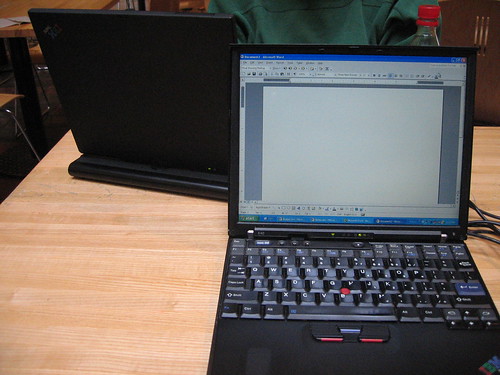
As many of you may already know, state Superintendent of Public Instruction Tom Horne has an initiative to set up 1-to-1 laptop programs at several pilot schools across the state( Horne's speech. News Article) There are several states that have already created 1-to-1 computer programs on much larger scales. For example, Maine was the first to do so statewide, putting a laptop into the hands of every 7th grader five years ago. link.

Many see the move to laptops as just another fad that looks cool but doesn't yield results. Recent reports about studies of some 1-to-1 programs out of Texas, however, back the effectiveness of 1-to-1 programs. In the February 2007 edition of the T.H.E. Journal an article looks at what the studies are showing. the article, 1-to-1 Computing :: A Measure of Success by Charlene O'Hanlon, notes that the programs have resulted in :better student motivation, increased teacher effectiveness, and developing student 21st Cetury Skills.

With such encouraging results. hopefully the legislature will agree to fund this program with an eye to expanding it even further next year.

Arizona Ed Tech Wiki

Educational Technology wiki supporting ed tech in Arizona is live: azedtech.wikispaces.com. The wiki is available to the public for viewing, but is currently only editable by the Technology Integration Specialists (of which I am one). My goal with this wiki is to provide information about educcational technology news, lesson ideas, discussion and support, focusing on Arizona.

Drop in and check it out.

Monday, February 12, 2007

College Professors going WEB 2.0

Today's Arizona Republic's website, AZCentral, has a great article about how professors at ASU and the University of Arizona are using Blogs, Podcasts, and Wikis to teach.
....
Blogs and podcasts are making their way into traditional college classrooms, changing the way students learn and professors teach. Learning becomes more interactive and can take place in the middle of the night.

Professors say the new learning modes improve their ability to communicate with students and foster more interaction among students.

"Many a quiet student has really come to life on their blogs," said UA lecturer Bill Endres, who uses blogs in English courses. "Some students actually have become stars in the social realm in classes because students think their blogs are funny."

The trend is inspired by students, who are no strangers to blogging and podcasting in their daily lives.
...
The article goes on to detail how these tools, often referred to as Web 2.0, are being used by the professors and the impact on the students. Clearly, the image of a stodgy old professor lecturing to a room full of bored students is on its way to becoming a thing of the past.

This is clearly where education is heading, and it is important to remember that it is not the tools that are important, but HOW the tools are used. This is how education needs to be transformed. In an article on today's (2-12-07) AZSTARNET talks about how education should be reformed. I think that following the lead of these colleges and professors is the way to go.

A side note: Podcasting may be a new concept for professors, but not so new to college students, who have been recording lectures for their friends and frat brothers who were unable to attend class on that day.

Friday, February 09, 2007

Gates on Learning with technology

Bill Gates spke last month at the Microsoft Government Leaders forum and talked about how technology will transform learning. Gates stated that the teacher is still a critical piece of the puzzle and that providing teachers in IT training is important. I think that almost all educators agree with this philosophy to some point. However, there is something that he said at the conference that is even more significant, and something that I think that we all need to pay heed to:
"We need to be humble in making predictions of how technology will affect education," Gates said, because people made big predictions about how TVs, video tapes and software would influence education that haven't come true.
I think that his comment is, as the British would say, spot on. Too often developments such as TV, laser discs and the such have been labeled 'silver bullets' that would revolutionize teaching and learning, only to fizzle out. Computers, technology, the internet and the such have been previously seen as the be all and end all of educational reform. The results have been far from what was hoped/promised, and there are those that quickly point to the failures in order to justify cuts to educational technology. We know that technology can improve the quality of teaching and learning, but we must avoid labeling it as an immediate solution. the transformation that technology can and will have on the entire educational process will take hard work, time, patience and money.
We need to be in this for the long haul and not promise magical overnight success.

Tuesday, February 06, 2007

The Power of the Internet

At the 15th Annual Teaching and Technology Conference held in Tucson the keynote speaker Alan November talked about the power of the internet, web 2.0 in particular. This video explains it all.


Tuesday, January 03, 2006

Misuse of PowerPoint?

PowerPoint has become one of the most popular software applications in the classroom. Too often, however, the use of 'slideware' is used to replace writing assignments/projects.
In an article published on WIRED.COM in September 2003, Edward Tufte addresses the negative impact of PowerPoint. The Article, "PowerPoint is Evil", attacks the tendency to focus on style over substance. This is especially true in education. Too many students and teachers get caught up in the WAY the information is presented; ie the colors, charts, graphs, animation, etc; vs the actual CONTENT.
Tufte states:
Particularly disturbing is the adoption of the PowerPoint cognitive style in our schools. Rather than learning to write a report using sentences, children are being taught how to formulate clie nt pitches and infomercials.

Many teachers DO use PowerPoint in this way, which is clearly a misuse of a powerful tool. That does not mean, in my opinion, that PowerPoint and other presentation software should NOT be used at all in the classroom. Teaching effective presentation skills, speaking as well as presentation design, should be a part of any curriculum involving technology. There are many websites and publications that provide excellent information on effective presentation design for those who are unsure of what constitutes effective presentation design(s).

One area that Tufte fails to address in this article as well as his writings on his website is interactive capabilities of most presentation apps. Teachers and students can create true multimedia learning tools that are non-linear, allowing the user to explore content. In the past, programs like HyperStudio were used. As software suites like Microsoft Office have become the norm on school comuters, the included presentation software (ie PowerPoint) has taken on this role. In fact, Microsoft has added features like custom animation paths to recent versions of PowerPoint. Such features were originally found only on HyperStudio.

There are many excellent uses of PowerPoint in the classroom to be found out there. I will be presenting a workshop @ the 14th annual Teaching and Technology Conference (see post below) on using the custom animation features of PowerPoint XP/2003 to create animated stories.